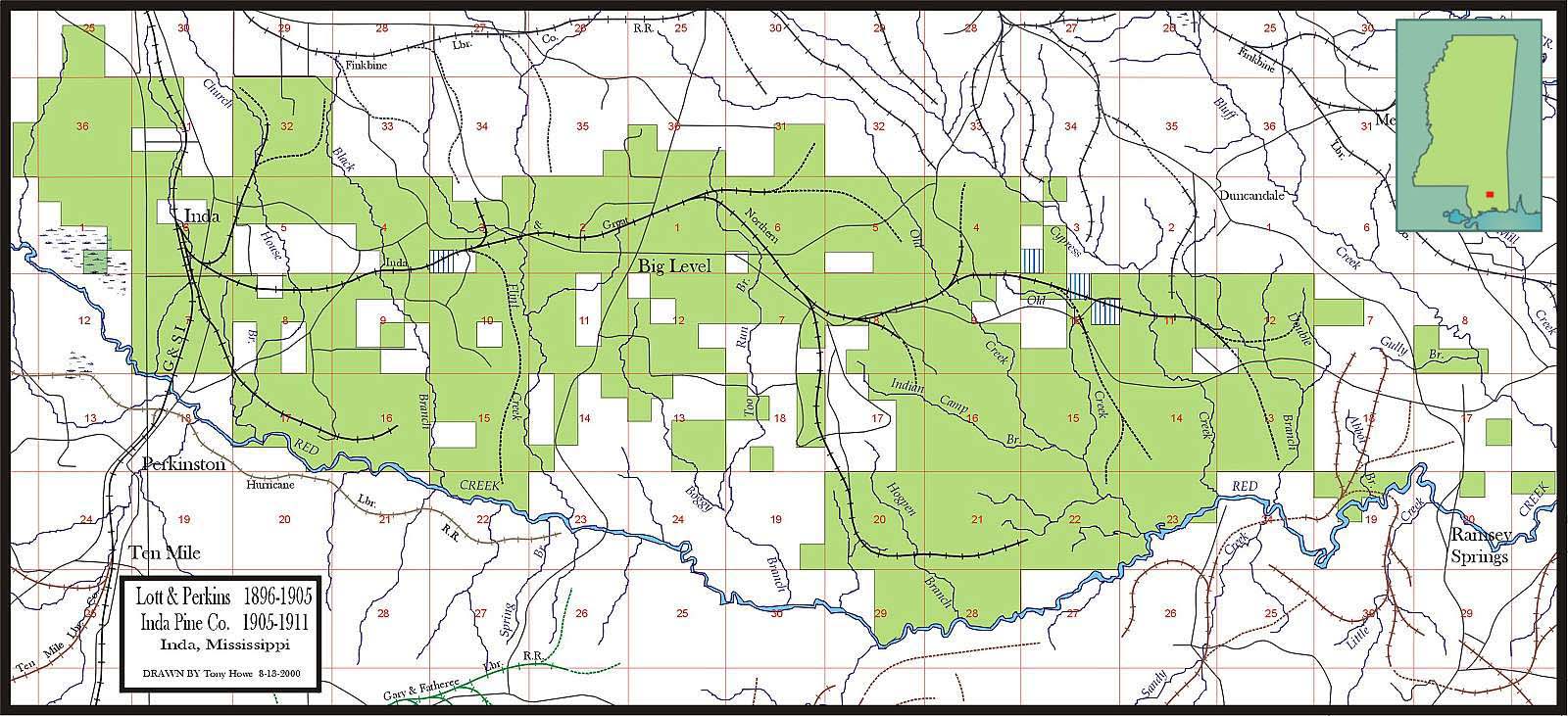
Lott & Perkins (1896-1902)
Lott & Perkins Lumber Co. (1902-1905)
Inda Pine Co. (1905-1911)
Inda & Great Northern Railroad
|
Standard gauge, 35 and 60-lb rail Headquarters: Inda, MS (Stone County) Mill Capacity: 75,000 ft/day Years of Operation: 1904-1911 Miles Operated: 20 Locomotives Owned: 4 |
Equipment 12 log cars in 1905
|
Click Map for Larger Version |
|
History by Gil Hoffman: The
partnership of Lott & Perkins began sawmilling operations at Inda,
Harrison County, on the Gulf & Ship Island Railroad, about 1896. William
Lott, of Harrison County, was secretary-treasurer and general manager. In
September 1900 the sawmill had a cutting capacity of 35,000 feet per day.
The specialty of the mill was export timber. Originally the mill was on west
side of the Gulf & Ship Island, but in December 1900 it was moved to the
east side. The Lott & Perkins Lumber Company, successor to Lott & Perkins, was incorporated at Inda, Harrison County, on July 29, 1902 by F. W. Lott, D. V. Perkins, William Lott, Peter Lott, E. M. Cowart and S. C. Culpepper with authorized capital stock of $100,000. On March 19, 1903 the charter was amended to raise the amount of capital stock to $200,000. The partnership of Lott & Perkins began sawmilling operations at Inda, Harrison County, on the Gulf & Ship Island Railroad, about 1896. William Lott, of Harrison County, was secretary-treasurer and general manager. In September 1900 the sawmill had a cutting capacity of 35,000 feet per day. The specialty of the mill was export timber. Originally the mill was on west side of the Gulf & Ship Island, but in December 1900 it was moved to the east side. The
Inda Pine Company was chartered in Louisiana in December 1905 by Sam R.
Guyther, of Patterson, La. (president and general manager), Henry M. Young
(vice president), G. H. Hovey (secretary and treasurer), and R. Cecil
Guyther (assistant treasurer). The company purchased the holdings of the
Lott & Perkins Lumber Company, at Inda, Harrison County, on December 16,
1905 for $260,000. Inda was on the Gulf & Ship Island Railroad about two
miles south of Wiggins. The cutting capacity of the sawmill was 75,000 feet
per day. A planing mill and dry kilns were also part of the plant. On
June 12, 1911 the sawmill plant, logging railroad and equipment were sold to
the Pine Export Company, of Gulfport. |
||
|
|
|
|
|
|
|
|
|
|
|
|
|
|
||
For more information contact Tony Howe at howe6818@bellsouth.net or David S. Price at dsprice46@bellsouth.net